
When you look at something, or a tiny spot on a something, you register it as a color. The color might be black or white or grey, but it is a color. So what makes up the color that you perceive? I’ve thought about this, and I don’t think there is an easy answer. Without further research (which means I might have something here wrong or left out something), I think the color that you perceive depends on the source of light (which means the wavelength and makeup of the light), the medium through which the light travels, the molecular structure of the thing that the light touches and reflects off of, the medium through which the reflected light travels, the condition and structure of the organ that receives the light, the physiology of the body (in my case human) that interprets the light, the experiential and genetic information used to interpret the light, and mostly, the degree to which the consciousness is paying attention in the first place. Some bodies perceive in other ways, e.g., by sound or physical sensation. And don’t forget the eyes of the giant clam. I’m focusing here on walking/swimming bodies with eyeballs. That’s complicated enough.
Thanks in a roundabout way to Artemis II, I have learned that the eyeball cannot see a passing beam of light. You can only see light that shines on your eyeball, either because you are looking directly into the source (like the Sun which will burn your eyeball and you should not do it) or because the light is reflected off something. The color of light from a source is determined by its atomic structure and temperature, which determines its wavelengths. The Sun emits all the colors, the full electromagnetic spectrum (more wavelengths than the human eyeball can see), and thus appears white from space.
The light then travels through a medium before it hits something and reflects. The Sun’s rays travel through the Earth’s atmosphere which scatters the light and changes the color of the Sun as we perceive it. When the Sun’s rays travel into water, the wavelengths are absorbed at different rates before they reflect off something, which dramatically changes the perceived color of the object. I can imagine that an object viewed on the top of Mt. Everest would appear to be a different color than it would at sea level, and I know for a fact that the same object would definitely appear to be a different color at 50 feet below the water’s surface.
After the light is altered by the medium through which it has traveled, it is then reflected off an object that is big enough for us to see, like a tree or a house or a shirt. The color of a leaf is determined by pigments in the leaf, which change based on temperature, season, exposure to light, environmental factors, and other variables.  The color of the tree trunk and bark is determined by polyphenolic compounds and whatever other life forms happen to be growing on them. The color of house paint (or any paint) is determined by the pigments that are added to the base and the light source reflecting off it. Pigments are chemical compounds that give a substance color through reflected wavelengths (or confusingly, absorbed wavelengths)–sometimes organic (like in leaves) and sometimes not (like in paint). I’ve searched “pigment” enough now to realize that it is a huge topic, too big for me here. I don’t claim to know what all these things are, but I’m going to go out on a limb and say that they all have an individual molecular structure.
So now the light has been emitted, traveled through a medium, and been reflected off a body. Next, the light travels through more medium until it reaches the eyeball. Depending on the distance and the medium, maybe the color doesn’t change much. But what if the distance between me and the tree is filled with smoke? Or maybe I’m underwater so there is more water for the light to travel through. You get the idea.
And then the light reaches the eyeball. What is the condition of the eyeball? And is it in a human? A few years ago I had cataract surgery. For two interim weeks, one eye had a cataract and the other one did not. I was shocked at the difference in what the two eyes saw. The colors viewed through the cataract lens were warm, and through the new lens the colors were much cooler—see the Kelvin color temperature chart. How about color blindness? That has to do with malfunctioning cone cells in the retina, which detect color. And what about afterimage? Afterimage is an image that continues to appear in the eyes after looking at the original image. They occur because of photochemical activity in the retina. I recall seeing a very yellow hat and, after turning away, seeing a blue hat everywhere I looked. Was the hat really yellow?
I think the biggest factor has to do with what species the eyeball is in. For example, dogs have only two types of cones in their retinas (compared with three in humans), which allegedly makes red, green, orange, and pink appear as brownish-grey or yellow tones. However, dogs have a higher number of rods than humans, which makes them see better in low light or at night than humans. As I have mentioned in other posts, the wondrous mantis shrimp has the most complex eye structure in the animal kingdom, with up to 16 different types of photoreceptors, compared to three in humans and two in dogs. They see UV, infrared, and polarized light. Their eyes move independently, rotate in three dimensions, and provide 3D depth perception. I can’t even imagine what the world must look like to them.
And finally, the information picked up in the eyeball is transferred to the brain, or something approximating a brain. What happens there? I perceive a life form that in English is called a “tree.” All the information and feelings I have accumulated about trees is lit up. I appreciate the individuality of the tree, its form, its age, the life it supports, the wind through its branches, how it grows through the seasons, its weak spots, whether it might fall on my house …. The color is essential in this process. The orange ball lies in the grass and the dog trots right by it. The blue ball lies in the grass in the twilight, and the dog races right for it. Something something for the mantis shrimp, and then something something else—how would I know?
So, when one person looks at a flower and says “isn’t that beautiful!” and another person looks at the same flower and says “meh,” what does that tell you? To me it says, “I don’t have enough information to make an assessment—too many variables.”
For a visual example of all this, see the below photos I took of the base of a sea fan at about 20 feet below the surface. I did not change the camera settings. The first photo is taken in natural light, i.e., no strobe (my personal portable sun). The second is with some strobe light, the third with more light, the fourth with too much light (aka “blown out”). Which is the true color? They all are.
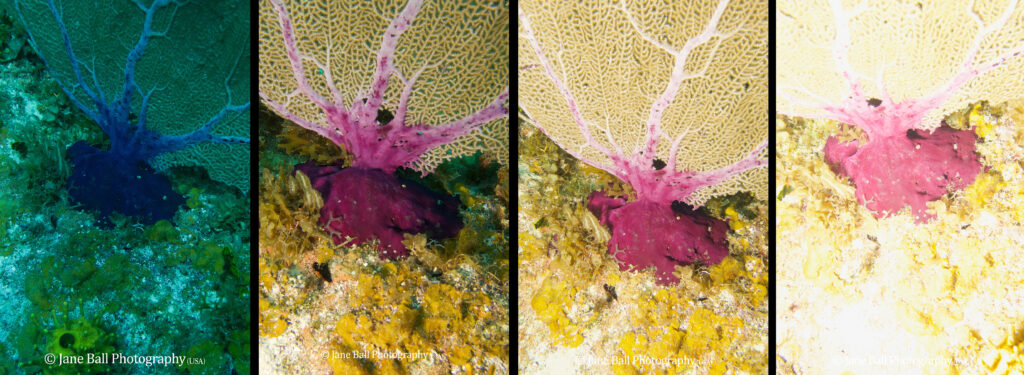
This fan is deep enough that not much of the Sun’s rays reach it. The light from the strobe has to pass through the water, reflect off the sea fan, and then travel back through the water to the sensor in my camera. Later, I download the image onto my computer, where I have the ability to manipulate the color if I choose. Next the image is posted on my website, where what you see is influenced by the performance capabilities of your particular brand, age, and quality of device. The image on the screen is reflected onto your eyeballs, and then all that other stuff happens. Color—it’s complicated.
PS – Since I wrote this post, two beautiful, tiny birds have killed themselves by flying into my windows. I used to have 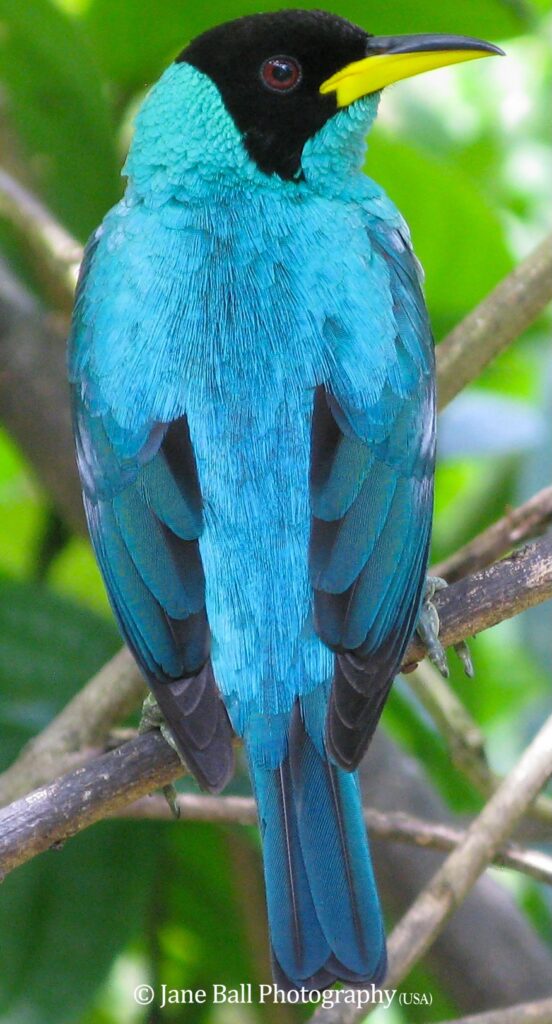 decals on the windows, but most of them have fallen off. So today, I hung some wind spinners in front of the windows. They are different from each other, which prompted me to wonder whether certain colors of spinners would be more of a deterrent, more visible to birds. As a result of looking into this, I have now learned that birds have four different kinds of cones in their eyes, one specifically sensitive to ultraviolet light. They see the colors that we do, but they see way more variations, tones, and shades than we can, as well as ultraviolet light. In fact, some of their feathers reflect UV light, which may distinguish male from female. Some chicks reflect UV light off their skin, which may tell the parents which chick is hungriest. Once again, color is in the eye of the beholder. But back to the windows. Various decals on the market, and also some liquids, appear almost invisible to us but reflect UV light very strongly to birds. I’m hoping that soon somebody develops a UV reflective decal or liquid or window film that is truly invisible to the human eye. There is a project underway to produce actual windows that reflect UV light. Of the billion birds that die each year in the U.S. from flying into windows, imagine how many bird lives that would save. Color saving life.