My first whale was a sperm whale. It was a happy, stylized whale in a children’s book I found in the library at my elementary school. I didn’t know at the time that it was a sperm whale. It was just a whale, and I loved it. From that point and for many years, I believed that a whale lived under my bed, which made me feel safe and gave me companionship.
Although I later had a few SeaWorld encounters with orcas (more a dolphin than a whale), my first up-close real whale was a beluga named Big Mouth. He and his companion, Little Girl, lived in a ridiculously small and barren tank at my local zoo. I visited them often and felt sad and ashamed that humans had forced them to live in such a situation. Big Mouth eventually got an infection (in his big mouth as I recall), and both whales were transferred to a SeaWorld somewhere and a larger enclosure. I hoped for the best for them.
Many years later, I encountered wild belugas in Hudson Bay. We tourists were each sent out into the bay in our own kayak to play with the hundreds of belugas that congregate there in the summer. They were rowdy and mischievous, bumping the kayaks and blowing whale snot all over us. Bobbing in the stillness and listening to whales blowing all around me and as far as the eye could see was a surreal and spiritual experience.
In my travels, I’ve seen many kinds of whales in many places. I have stories about grey whales and sperm whales and minke whales and orcas. But my first love are the humpbacks. Humpbacks are in most of Earth’s oceans. I have seen them in many places, but a few encounters really stand out. In the whaling days, they were hunted almost to extinction. Now most populations have rebounded to a total estimate of 80,000 to 135,000, still short of their pre-whaling numbers. As a keystone species, their value to the ecosystem of the Earth is critical (e.g., see my prior post Phosphorus, Nitrogen, and Iron). I found another video that explains the importance of whales and their poop,
My first really significant encounter with humpbacks was at Silver Bank, a reef system about 80 miles off the coast of the Dominican Republic and part of the Sanctuary for Marine Mammals. It is the largest mating and calving ground in the North Atlantic Ocean. During the season of January-April, a few permitted liveaboards (boats you can live on) make the transit to Silver Bank and spend a week anchored there. Two daily excursions in tenders are offered so that guests can spend time surrounded by humpbacks and snorkel among them. My first careful entry into the water (because you don’t want to disturb the whales) was right on top of a full grown whale lying asleep on the bottom about 50 feet below me. While we watched, it slowly angled up until its head was at the surface and its tail was still on the ocean floor. I felt so small and also so privileged. There were a few other encounters during the week that will stay with me for life.
The next significant encounter was on my friend’s 70th birthday, exactly on her birth date, in Antarctica. We were in Cierva Cove on the Antarctica Peninsula, and it was snowing hard. The water was filled with Zodiacs full of tourists, kayaks full of tourists, icebergs sometimes covered with birds, and humpbacks feeding. The boat captain and crew estimated there were at least 50 humpbacks, all spyhopping, lunge feeding, and diving, sometimes directly under our Zodiacs. You can see some photos in the Antarctica gallery. We stayed for hours, and it felt like 10 minutes. What a mass of krill there must have been unseen to us, and what a sight to behold! There was so much activity in the air, on the surface, and under the water—everywhere!
The next encounter was not so “up close,” but was also action-packed on a much more sedate scale. This one was in the Hawaiian Islands Humpback Whale National Marine Sanctuary off the coast of Maui (https://hawaiihumpbackwhale.noaa.gov/). This is the largest mating and calving ground in the North Pacific Ocean. During November through April, 10,000+ humpbacks migrant to this Sanctuary. There are many whale-watching boats of all sizes and types. Some enthusiasts spend weeks there, going out on the boats all day every day. Boat behavior is regulated. Here is where I learned about Happywhale. Happywhale is an organization that tracks the life cycle of whales, mostly humpbacks, with the help of citizen scientists. Each whale tail is like a fingerprint, different from every other tail. A whale watcher uploads their photos of whale tails, with information about where and when, and the Happywhale database analyzes the markings on the tail and records sightings. After sending in a photo, Happywhale will tell you whether this is a whale already in their database. If you request, Happywhale will thereafter send you notifications every time one of “your” whales is sighted. If it is a whale that is new to the database, you have the opportunity to send them a lot of money (a charitable contribution to their fiscal sponsor, Whales of Guerrero) and name the whale. (Actually, I believe anyone may contribute and name any of the unnamed whales in their database.) Happywhale’s database is kept as “an archive and public service for research, education, conservation and entertainment.” I left Maui with lots of photos of whale tails and every intention of uploading them to Happywhale …, but I didn’t.
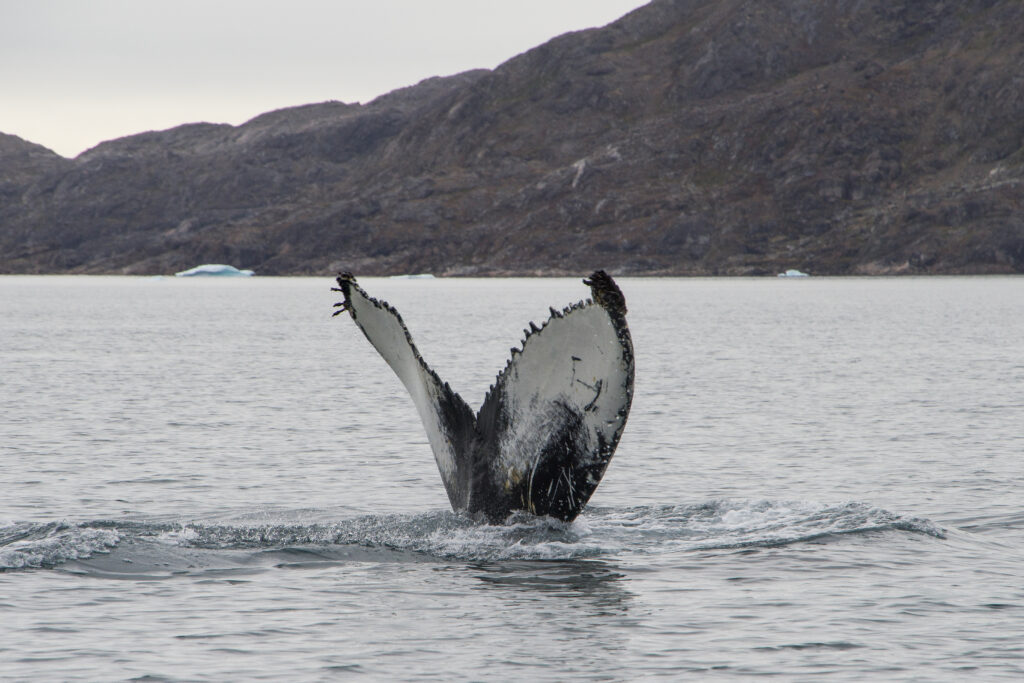
A couple years later (and a couple years ago), my friend and I went to Greenland. Humpbacks were everywhere. On our last day there, our group was split onto two small fishing boats which toured us to the base of a glacier. On the way, we saw two humpbacks. On the way back, we spent some time watching the whales, and I heard, once again, about Happywhale. I took more photos. One of the whales had a tail that was almost fringed, something I had never seen before. Like all of Greenland, these whales were magical.
When I got home, I gathered all my photos of whale tails that I had taken over many years and uploaded them to Happywhale, https://happywhale.com/user/34233. (I am user 34233.) Every one of my tails was already in the database, except for the two whales in Greenland. I took my opportunity and my fistful of money and named one of the whales, the one with the fringy tail. I named it Tootega, which in Inuit mythology is an old goddess who walks on water (https://happywhale.com/individual/126297;enc=493518). It seemed appropriate. Since then, I have received many notifications of subsequent sightings of whales I saw in Hawaii and Antarctica, but so far, no one else has reported a sighting of either of the Greenland whales.