
Last October, my friend and I spent a week at Kakslauttanen Arctic Resort in Lapland, Finland. October was too early for snow activities and too late for many of the summer activities. At first, it seemed like there would not be enough to do to fill up seven days. In the end, I came away with plenty to think about.
The Sámi are the indigenous people of Sámpi, the northern area of the Scandinavian countries and a tip of Russia. In Finland, this area is called Lapland. The Sámi rely on reindeer which are part of their culture and survival. What I remember being told is that the reindeer are loose during the summer, and as they wander south in the fall, they are rounded up by the Sámi. Some are herded into enclosures on the Resort where they are “employed” by the Sámi to provide excursions for the Kakslauttanen guests, thus providing income for the Sámi. Think “sleigh rides.” The reindeer wander everywhere, including on the main highway between the airport and the Resort where sometimes braking for reindeer is required.
One day while wandering around the 1,200 acres of the Resort, we came upon the reindeer enclosure. As we watched, a truck pulled up and unloaded more reindeer. 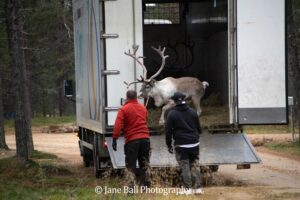 This was my first opportunity to look closely at reindeer. As a photographer and generally tidy person, I noticed the antler sticking out in front, encumbering my view of their beautiful faces. They all seemed to have this annoying feature, and so I have had to learn about reindeer antlers and the brow tine.
First, briefly, reindeer versus caribou. I have read a lot of posts. Many posts say reindeer and caribou are the same thing—called “reindeer” in Europe and “caribou” in North America. Other posts say that reindeer and caribou are closely related, but are different subspecies. In fact, there may be six or more subspecies of Rangifer, some of which are extinct. This is not my area, and I don’t know what is correct, but at the very least I think it’s safe to say that reindeer and caribou are related and of the same species, Rangifer tarandus. Also, they both seem to have the same antler situation.
Reindeer/caribou are the only deer species where both males and females grow antlers. Males begin to grow their antlers around February; females around February or May, depending on whether they have a calf. Both finish growing in late summer, after which the males use their antlers to beat each other up during the rutting season. In late November the rutting season ends, and their antlers fall off. On the other hand, most females keep their antlers until May, which they use to protect their calves and scrape for food. The very few females who are not pregnant lose their antlers around February. Most females give birth at the same time, no matter when they were impregnated. Even though the females lose their antlers at different times from the males and from each other, they all somehow work it out so that every fall they all have another grown pair of antlers around the same time.
Take a moment to think about this. All the males have lost their antlers by December, and all the females still have their antlers in December. What about Santa’s sleigh? I confess I too had assumed Santa’s reindeer were male. Researching a little further, I found that Rudolph is indeed male, and the original drawings show him without antlers—accurate. Other drawings show Rudolph with antlers, which would make Rudolph a girl. Rudolph was the child of Donner and Donner’s wife. As you know, Donner was one of Santa’s reindeer, who is drawn as having antlers. It’s messed up.
Reindeer have the largest antlers relative to body size of any living deer species. The number of points and general size increase every year until around five or six years old, after which they remain more or less constant. General health and environment also play a part in the antler size each year. Antlers grow one to two inches per day, which is among the fastest growing tissues of any animal. The antlers finish growing in late summer/early fall, when they harden and the “velvet” is rubbed off (which takes around 12 hours). Check out the velvet hanging off the antlers in this photo. 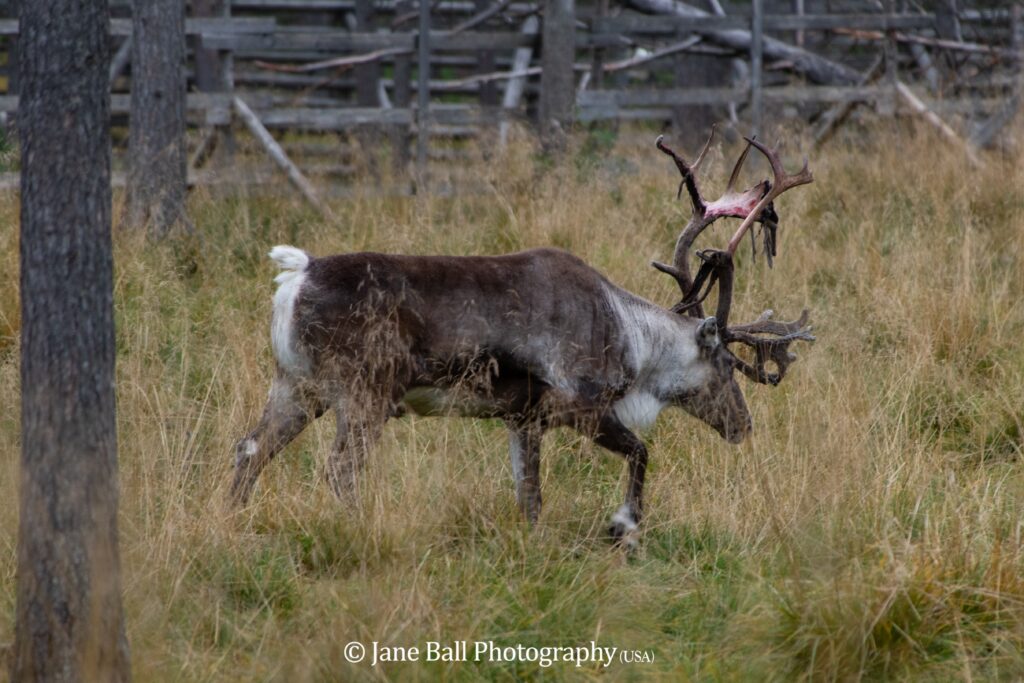 The velvet is full of blood vessels to nourish the antler growth, but allegedly it doesn’t hurt when the bloody velvet is rubbed off. Ultimately, males can have antlers up to 50 inches long, and females up to 20 inches. The rack can weigh up to 33 pounds.
The branches that grow from the main antler beam are called tines. Apparently there are lots of deer with tines that grow from the base of the antler and stick out toward the front—brow tines. After looking at photos of more dead deer bucks with massive racks than I ever wanted to see, it looks to me like brow tines are not all created equal. Antlers in the deer family are almost always symmetrical, but reindeer/caribou have a brow tine which generally grows off the base of only one of the antlers (often the left one) and projects forward between the eyes. The brow tine is usually very palmate (flat), also known as a “shovel.” The reindeer brow tines protect the eyes when sparring and possibly also when scraping the ground for food. 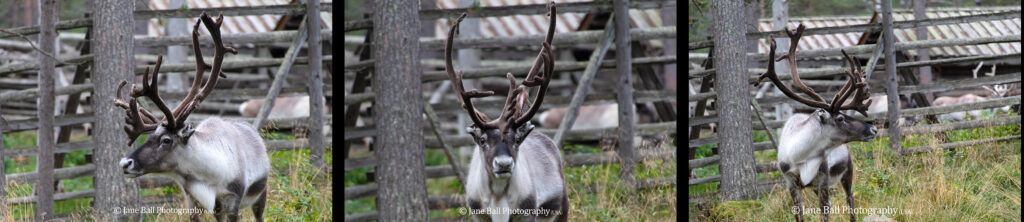
(A side opinion about trophy hunting: I don’t understand why hunters are so proud to kill the biggest and most virile of a species they can find. It seems to me that this only weakens the gene pool, reverses natural selection, and over time, has lasting consequences that lead to a diminished species, e.g., the tuskless elephants of Mozambique.)
Reindeer are remarkable in a few other ways too, ways that enable them to thrive in the Arctic. One is body temperature regulation. In the extreme cold, the body temperature of a reindeer’s legs, which are mostly tendons and ligaments, is kept at about 33°F, while the chest and abdomen, where most of the muscles are, are kept at the normal body temperature of 101.5°F, i.e., they don’t get cold? Reindeer keep warm because of their incredibly thick coat and hollow fur (which also allows their bodies to ride high in the water when they are swimming) and also because of their magic noses. Their internal nasal surface area is huge and complex, which allows them to exchange heat and water vapor inside their nose, losing little to the outside world and warming the air as much as 80 degrees before it reaches their lungs. The colder it is, the more efficient the nose becomes. This is why we see very little “steam” when a reindeer breathes in extreme cold.
Also, reindeer can see light with short wavelengths in the ultraviolet range not visible to the human eye. This helps them see objects in the snow like food and predators that would be hidden to the human eye. Their eyes also change color through the seasons to adjust to the huge swings in the amount of daylight.
And finally, as you know, they can fly. Their magic noses help keep them warm both at high latitudes and at high altitudes. … Do you suppose caribou can also fly?
https://en.wikipedia.org/wiki/Reindeer
https://en.wikipedia.org/wiki/Rudolph_the_Red-Nosed_Reindeer
https://animals.sandiegozoo.org/animals/reindeer-caribou
https://www.bbc.com/news/science-environment-13529152
https://www.sintef.no/en/latest-news/2016/the-magical-reindeer-nose/
https://nolinkpreview.com/www.sciencenews.org/blog/wild-things/reindeer-eyes-change-color-winter-darkness